
Follow one answer through preparation
Use a stakeholder question to examine what the preparation workflow helps you do.
Choose the experience
“Tell me about a time you handled a difficult stakeholder.”
Start with the target role and choose an experience that reveals relevant judgment. In HireKey, role context sits alongside application materials; Big Interview organizes learning and question practice.
Work through your contribution
What did you decide, say, or change?
Separate your action from the team’s work. HireKey’s coaching workflow steps through STAR elements; Big Interview’s recorded practice and feedback provide another way to review an answer.
Review the next attempt
What specifically should improve?
Choose a shorter setup, a clearer decision, or a more direct result. Compare how each workflow helps you identify and practice that change, rather than treating a score as the objective.
Compare the preparation workflow first
Big Interview and HireKey overlap in interview preparation, but they organize that work differently. Big Interview centers structured learning, recorded practice, and feedback. HireKey connects preparation with a target role and the surrounding application workflow.
The most useful comparison starts with the task you want to complete. You might need a course that explains interview techniques, repeated practice on a recorded answer, or a way to connect the job description, resume evidence, and interview preparation. Those are related needs, but they are not interchangeable.
For a job seeker evaluating HireKey, the question is whether role-specific preparation and connected application context solve the problem you are facing. Compare the same task across each product rather than judging by the length of a feature list.
Two routes through interview preparation
Big Interview
Learn, record, review
- Work through interview-learning materials.
- Select questions and record practice answers.
- Review feedback on the answer and its delivery.
- Repeat the answer with a specific improvement in mind.
HireKey
Connect the role to your evidence
- Bring the target role and job description into preparation.
- Identify relevant experience and likely areas to discuss.
- Practice an answer, including voice coaching when useful.
- Keep preparation alongside the rest of the application workflow.
The distinction matters when preparation feels unfocused. A lesson can explain a technique, but you still need to choose experience that answers the question. A role-specific prompt can make practice more relevant, but you still need to work through the answer clearly.
Think about where you get stuck. If your opening is vague, work on choosing and organizing the evidence. If an answer is difficult to follow aloud, review its length, structure, and delivery. A tool’s feedback is most useful when it leads to a concrete revision.
Big Interview vs HireKey at a glance
| What to compare | Big Interview | HireKey |
|---|---|---|
| Learning materials | Structured interview lessons, question practice, and salary-negotiation training. | Preparation organized around a target role and interview stage. |
| Practice format | Recorded video answers with AI feedback available through its practice tools. | Role-specific preparation and voice coaching, with spoken or typed responses in the coaching workflow. |
| Feedback emphasis | Published materials describe feedback on content and delivery, including pace, vocabulary, and eye contact. | Voice coaching guides the answer through STAR elements and provides a debrief. |
| Job-search context | The product also includes resume-related and negotiation resources; its interview workflow is the focus here. | Resume-to-role comparison, tailoring, cover letters, company research, interview preparation, and application tracking. |
| Free access | The personal pricing page lists paid plans. A continuing free personal plan was not listed there when checked. | A free plan includes monthly allowances for tailoring, interview practice, voice coaching, cover letters, and company research. |
| Paid personal pricing | US$39 for a monthly subscription; US$99 for three months; US$299 for lifetime access. | Premium is US$39 per month. The pricing page does not list an annual plan. |
Pricing checked November 4, 2026. Prices are in US dollars; plan terms and allowances can change.
These differences describe the published workflows. They do not establish that one product produces more interviews or offers. A useful evaluation looks at the quality and relevance of the practice you can complete.
Use one interview task to assess the workflow
Choose a question you expect to need, such as “Tell me about a time you handled a difficult stakeholder.” Prepare the same core experience: the situation, your responsibility, the decision you made, and what changed afterward.
Then look at four things in the preparation experience:
- Context: Can you connect the question to the actual role and its responsibilities?
- Contribution: Does the practice help distinguish your actions from the team’s work?
- Feedback: Can you identify a specific change to make to the next answer?
- Repeatability: Can you return to the answer and practice the part that needs improvement?
Do not let a score become the whole objective. You should be able to explain what improved: a shorter setup, a clearer decision, a more specific result, or a direct answer to the question. Those changes are easier to carry into a real conversation than a memorized script.
For a broader practice method, read how to use AI for interview prep without sounding scripted. That guide covers the preparation approach; this comparison focuses on how the products organize the work.
See how HireKey structures a coaching turn
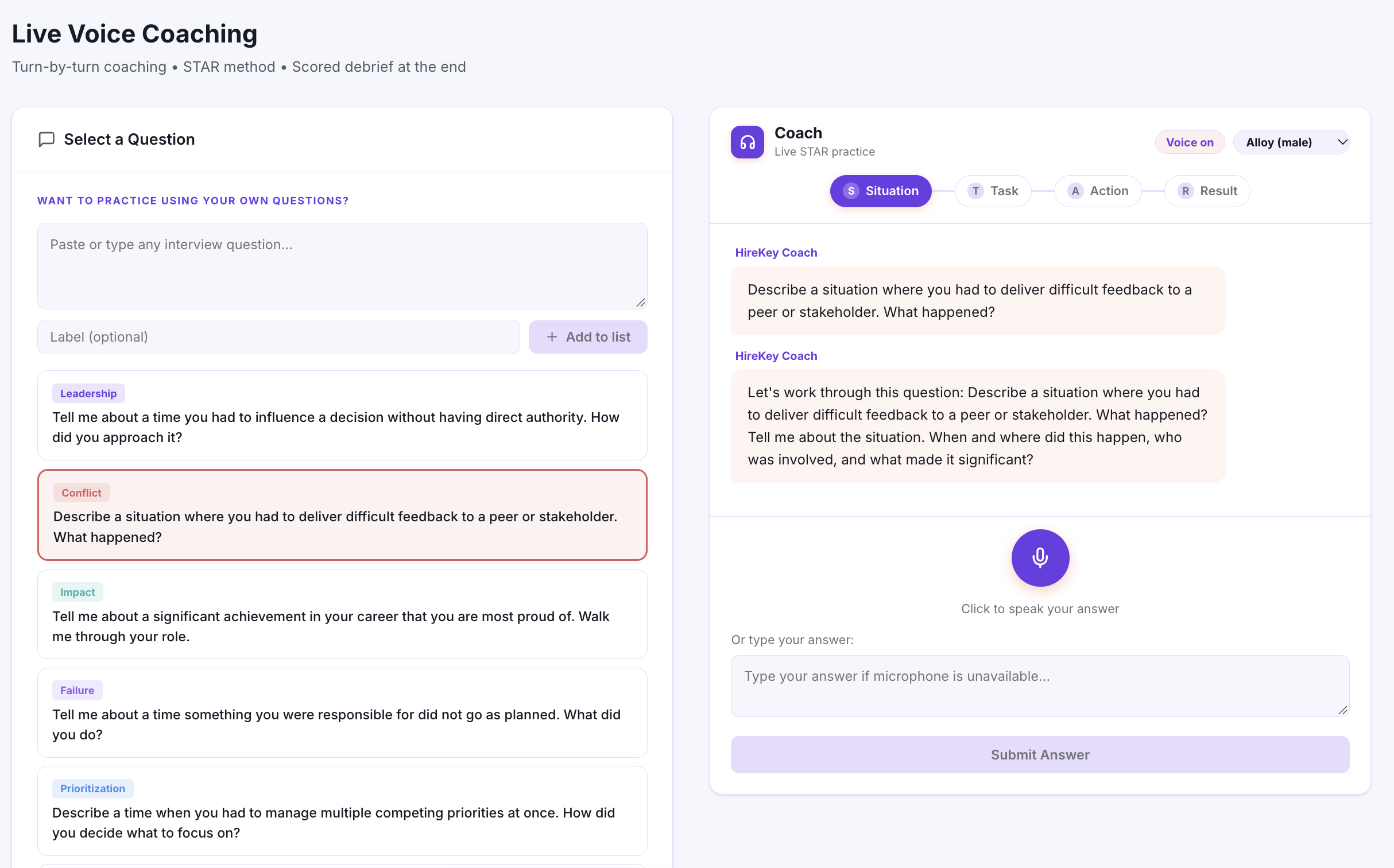
HireKey Coach · Situation
Describe a situation where you had to deliver difficult feedback to a peer or stakeholder. What happened?
Tell me about the situation: when and where did it happen, who was involved, and what made it significant?
Speak or type your response
In this view, the prompt asks the candidate to establish the situation before moving through the rest of the answer. That creates a focused revision task: explain when and where the event happened, who was involved, and why it mattered.
The next useful step is to connect that setup to your own responsibility and action. An answer can be fluent while leaving the listener unsure what you decided. Keep checking whether each part adds information the interviewer needs.
Match the plan to the amount of practice
Plan limits matter when you want several attempts across multiple roles. HireKey’s current pricing page lists five interview-practice uses and two voice-coaching uses per month on Free, and fifty interview-practice uses and ten voice-coaching uses on Premium.
Big Interview’s personal page lists monthly, three-month, and lifetime purchase options. Compare the total payment and access period with the time you expect to spend preparing. A lower average monthly cost does not necessarily mean a lower commitment.
Also consider whether you need preparation alone or help with other parts of the search. Resume tailoring, company research, and application tracking may matter to your workflow, but they should not distract from checking whether the interview practice itself is useful.
What to look for when evaluating HireKey
HireKey brings role context and application work into the same preparation process. Evaluate it with a real opening you are considering and an experience you are ready to discuss. Check whether the questions are relevant, the coaching helps you clarify your contribution, and the workflow makes the next practice session easier to start.
Keep the final answer in your own words. Interview preparation should help you explain the work and respond to follow-ups, including when the interviewer changes direction.
Explore HireKey’s interview-preparation workflow to see how role context and answer practice fit together.
Common questions
Does Big Interview include more than video practice?
Yes. Its published materials also describe interview-learning content, resume-related resources, and salary-negotiation training. Video practice is one part of the product.
Does HireKey include voice interview practice?
Yes. HireKey includes a voice-coaching workflow with spoken or typed responses and an answer debrief. Monthly allowances vary by plan.
Can either tool guarantee the questions I will be asked?
No. Preparation questions can help you organize relevant experience, but an employer may ask different questions or follow up in a different direction.
What should I practice before the first recruiter conversation?
Start with your background, relevant experience, motivation, and practical questions about the opportunity. The recruiter phone screen guide gives you a focused preparation task to use when evaluating a workflow.
Should I research the employer before practicing answers?
Understand the role and company context so you can choose relevant experience. HireKey company research supports that preparation; it does not establish which exact questions an interviewer will ask.